
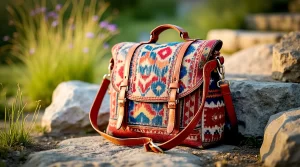
Ethnic bags: a craft inspired by time and nature
Every morning begins with the search for the right bag—one that can hold everything needed

Embroideries are hung so that the strengths of each piece remain visible while all of them work together harmoniously. During celebrations, decorative embroidery holds a special place in the home. It is used as bed covers and curtains and to adorn the walls. The newlyweds’ room is decorated with particular care.
During the day, blankets and pillows stored in large niches are covered with decorative takyapush embroidery. These deep niches begin at floor level and are built into the end wall opposite the entrance. Between two large niches is a narrow divided recess for storing linen, concealed by an embroidered choyshab curtain. Along the upper part of three walls runs a long, narrow embroidered zardevor frieze. Embroidered cases for small household items hang on the walls: a shona-khalta for a comb, a chorsu for a man’s waist scarf and an oyna-khalta for a mirror.
These genuine works of folk art accompany people from childhood to old age, shape taste, and awaken a sense of beauty.
Large decorative suzanis were usually created for the most important family occasions. A bride’s household prepared especially varied embroidery for a wedding. These pieces formed an essential part of the dowry and a complete set needed to begin the young family’s life.
Embroidery also held an important place in wedding rites. A ruyijo wedding sheet, patterned along three edges, was spread on the newlyweds’ bed; bolinpush embroidery was placed over the pillows, and a suzani was laid over the blanket. In wedding ceremonies, magical power was also attributed to the ornamentation of embroidered pieces, which were meant to protect the newlyweds from every kind of evil force. Following an ancient custom, embroiderers left a small part of the pattern unfinished in the completed work, ‘so that weddings would never cease in the house, so that the daughter would live, and so that joy in the home would never be interrupted.’ At times they addressed the future owners of the suzani directly in an inscription, as an unknown craftswoman from Urgut did when she wished that ‘the bolinpush would delight the eye and bring joy to the person who would own it.’ Over the centuries, the Uzbek people developed a deep love for beautiful patterned embroidery. Women were the main creators of these artistic works. Old patterns and sewing methods passed from mother to daughter. Girls learned the art of embroidery from childhood so that they would become skilled craftswomen. Each family made its own decorative embroidery. A suzani, for example, required one and a half to two years of work. A mother began embroidering her daughter’s dowry while the girl was still young. When a family could not complete all the embroidery needed for the wedding on its own, relatives and neighbours came to help.
Female artists and pattern designers created the drawings for embroidery. They knew many traditional ornaments and continually varied them to produce new compositions. Their art was always treated with special respect. It was often passed from mother to daughter, although every neighbourhood in a large city had its own pattern designer.

Colour plays the leading role in Uzbek embroidery. Most works impress viewers through the detailed treatment of large, fully embroidered ornamental forms. This detail is developed through colour, which greatly enriches the ornament, rhythmically divides the surface and transforms it into a vivid decorative plane. A single work may contain up to fifteen shades, allowing rich colour combinations while preserving the unity of the overall palette.
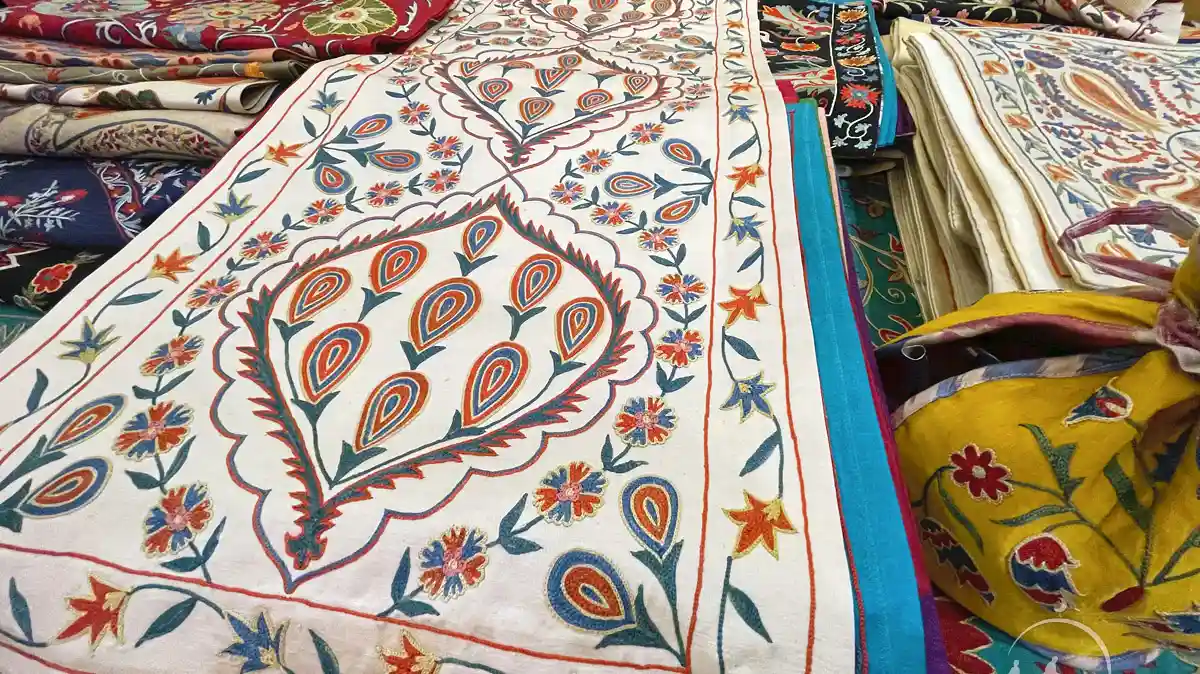
Red tones dominate embroidery worked on a white background, creating a lively and joyful palette. Flowers and rosettes are stitched in reds, while the leafy parts of the ornament are green. Stems, branches and leaf outlines use olive and pale-sand shades. This palette broadly follows the natural colours of plants, yet it is also built on the vivid contrast between red and green. Embroidery may combine contrasting yellow and violet, orange and blue, red and blue, green and orange, or black and white. At the same time, neighbouring areas may use several shades of one colour, such as pale blue with cornflower blue, light yellow with gold, or dark crimson with a lighter crimson tone.
The main ornamental image in embroidery is a lush, flowering garden. Even details based on animals or everyday objects acquire a plant-like form. Flowers moved from gardens and flowerbeds into decorative work and, transformed by the imagination of craftswomen, became joyful folk patterns. Ornamental motifs expressed wishes for happiness and prosperity and symbolised fertility.
Some embroideries reproduced a stylised women’s silver ornament with pendants known as a tumar. Just as the tumar itself—a case containing a prayer—was worn as an amulet, its embroidered image was believed to possess protective power. Bright, colourful birds can often be seen among bushes, branches and flowers. These images are particularly interesting because birds are almost the only living creatures preserved in folk art despite Islamic prohibitions on figurative representation. In rare cases, individual works also contain silhouettes of animals and people. The embroiderer usually places them discreetly at the side or edge rather than in a prominent, eye-catching position.
Until almost the end of the nineteenth century, large decorative embroideries were usually worked on white or slightly reddish homespun cloth. From the beginning of the twentieth century, local silk fabrics in purple, green, and orange, together with white and coloured factory-made cotton cloth, came into widespread use.
The exceptional beauty of nineteenth-century embroidery is partly explained by silk threads coloured with natural dyes, which produced deep, soft, shimmering shades.
Over centuries, regional characteristics developed in embroidery. The Nurata, Bukhara, Samarkand, Urgut, Shakhrisabz, Tashkent, and Fergana schools each have their own identity.
A distinctive type of embroidery developed in Nurata. In the nineteenth century, it was a large settlement and the centre of the Nurata beylik of the Bukhara Emirate, conducting trade between nomadic and settled peoples. Nurata embroidery has clear, strongly defined features that make it easy to distinguish from work produced elsewhere. Local pieces are decorated with floral bouquets spread across a white cloth background. In the richness and variety of their floral motifs, they occupy a leading place among Uzbek embroideries. Birds often enliven the plant designs, and heavily stylised images of animals and people also appear from time to time.
The most common design in Nurata is a closed composition with an eight-pointed star in the centre and four large bouquets in the corners. Another type of ornament uses a diamond-shaped lattice formed by serrated leaves. Its cells are filled with flowering branches, rosettes, birds and animals. Some embroideries arrange separate floral motifs in a chequered pattern across the cloth. The colour combinations within individual motifs are particularly refined: one flower may have yellow and golden petals, another blue, pink and cream; on a branch beside pale-turquoise leaves grow blue flowers with pink centres. By the middle of the twentieth century, the art of Nurata embroidery had almost been lost. Only in recent years has craftswoman Mukarram Rajabova revived the traditions of her ancestors.
Bukhara embroidery is among the most beautiful in Central Asia. Its appearance reflects the centuries-old artistic traditions of a city with more than two thousand years of history. A distinctive feature of Bukhara embroidery is the masterful use of chain stitch, which was used for most pieces, as well as subtle colour combinations of blue, grey, lilac, pink and pale yellow alongside red, crimson and green. The compositions and patterns of Bukhara works are highly varied. A closed composition with a clearly marked centre and corners is especially common, with a round rosette as the main motif. The rosette is remarkable for the diversity of its details, which create ever-new variations of the basic design. Not only the suzani and bolinpush of Bukhara, but also joynamaz prayer rugs and ruyijo sheets, possess outstanding artistic merit. The light, freely arranged floral pattern of a joynamaz creates an enchanting impression. A decade ago, the Majidov family of Bukhara began producing embroidery based on old ornaments, much like that made a century earlier. They use handwoven cloth for suzani and natural dyes for the silk threads.
For many centuries, Samarkand was a major centre of artistic crafts. Its embroidery contains archaic features that connect it with the art of ancient Sogdiana. Unlike the works of Nurata and Bukhara, Samarkand embroidery has larger and more concise designs. Its main motif is a round rosette in crimson tones, surrounded by a ring of leaves. The artistic strength of Samarkand embroidery lies in the decorative clarity of its simple, large-scale pattern. In mid-nineteenth-century works, the round rosette contains multicoloured concentric and ray-like details, while dark-green leafy rings are enlivened by a rainbow stripe or a pale-green centre with a bright-red vein. By the beginning of the twentieth century, the style of Samarkand embroidery had changed. Earlier works impressed viewers with the delicacy and variety of their patterns and the restraint and nobility of their harmonious colours; newer pieces captivated them with the power and simplicity of expressive forms and contrasting colour combinations.
Embroidery from the old town of Urgut in the Samarkand Region leaves an unforgettable impression. Suzani worked in bosma stitch on white cotton, and less often on crimson or yellow silk, reproduce some of the most ancient magical patterns. Pupils of the renowned Urgut embroiderer Sakhobat Rakhmatullaeva decorate vast panels with crimson circles outlined in black, symbolising the sun, together with blue and yellow stylised stars, lola tulips and plant leaves. The Urgut craftswomen’s close observation of nature and imaginative view of the world sometimes allow them to stylise everyday objects with great skill while remaining true to embroidery traditions. Teapot motifs, for example, can be found in suzani ornament. The dense, raised embroidery of an Urgut suzani covers almost the entire surface, while small areas of white cloth merely provide a background for the vivid design.
Skilled hand embroiderers have long lived and worked in the towns and villages of the Fergana Valley. Their pieces are usually made on dark-green or violet silk or satin and have light, graceful patterns arranged freely across the unstitched background. Most are ruyijo, with large gulkurpa or suzani pieces appearing less often. Ruyijo commonly use a repeated motif of a flowering bush with scalloped, flowing leaves. Pale silhouettes of ornamental motifs also look striking against a dark background. The main motif of most large embroideries is a round rosette formed from concentric rings.
All the artistic means used by embroiderers—the construction and decorative interpretation of the ornament, colour, material texture, and stitching technique—are inseparably connected. They complement and strengthen one another and together create a harmonious work of decorative art.
Uzbek hand embroidery is a powerful branch on the tree of folk art. Ancient mythological symbols in suzani ornaments, enlivened by the imagination of women masters, embody continuity of tradition and the poetic soul of the people.
Every morning begins with the search for the right bag—one that can hold everything needed
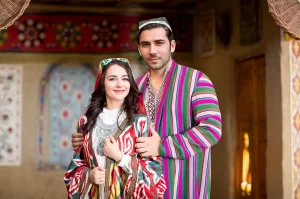
Uzbek clothing is a vivid symbol of the country’s culture, history and rich traditions. Over
Let us admit it: in everyday life, we rarely think much about keeping the house
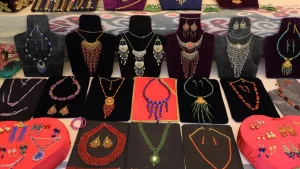
Uzbek costume jewellery is a distinctive world of vivid colours and graceful forms permeated by