
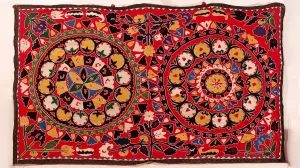
Uzbek suzani
A visitor accustomed to a Western lifestyle may be surprised on first entering a traditional

In the pre-Islamic era, clay idols protected the family hearth from misfortune; clay whistles were made for children; and the material was indispensable for tableware. It is therefore unsurprising that pottery has long been one of the most honoured and respected among the many crafts practised by Uzbeks. Every region of the country has its own ceramic school, with traditions rooted in the distant past.
On the hills of the Afrasiab archaeological site outside Samarkand, archaeologists discovered numerous terracotta figurines of fantastic animals, dragons and lions, as well as fragments of ceramic bowls painted by unknown masters who lived in legendary Marakanda fifteen hundred to two thousand years ago. In the mid-twentieth century, folk ceramic artist Umar Jurakulov carefully studied the scholars’ finds, old ornaments and sculptural methods, and began modelling whimsical figures that revived the ancient art. Today, in a Samarkand pottery workshop on a street named after this celebrated master, his pupils and their pupils continue the traditions of Afrasiab ceramics. Amusing riders on donkeys and horses, scenes observed in teahouses and bazaars, maskharaboz clowns and, of course, miniature dragons—these terracotta works have become some of the finest souvenirs for visitors wishing to remember a journey to Samarkand.
Many craftspeople make clay toys, but only a few bring this simple amusement to the perfection of a genuine work of art.
A whistle toy once brought international fame to the remarkable hereditary artisan Khamro Rakhimova from the old village of Uba. Today, her pupil and keeper of the tradition, Kubaro Babaeva, teaches her own students to model brightly painted, piercingly whistling multi-headed horses and lambs.
Not far from Uba, forty kilometres from Bukhara, lies the small town of Gijduvan, once famous for its ceramics throughout the Great Silk Road. It is home to the renowned master Alisher Narzullayev, a full member of the Academy of Arts of Uzbekistan and a sixth-generation ceramic artist. His lyagan dishes, pialas, bowls and vases carry patterns reminiscent of peacock feathers. Bright pigments softened beneath a thick layer of glaze take on the gentle, painterly quality of watercolour. Alisher learned from his father, master Ibadullo Narzullayev, the secrets of working on the charkh potter’s wheel, shaping unusual clay forms and painting them.

Khiva, one of the world’s oldest cities, gave rise to the Khorezm school of ceramics, distinguished by the monumental clarity of its geometric designs. Pottery patterns strongly echo the majolica decoration covering the walls of the famous monuments of ancient Ichan Kala. This is because today’s artisans are direct descendants of the folk masters who decorated khans’ palaces and mosques. Modern kulol potters use the same natural ingredients to prepare ishkor glaze that their ancestors used to create unfading dark-blue, sky-blue and turquoise tiles.
In every part of the republic, a lover of pottery can find a distinctive style of painting, purity of decorative form, and a vivid sense of handwork. A true admirer of blue ceramics, however, will seek the Fergana Valley and the town of Rishtan.
Historical accounts suggest that pottery arose in Rishtan about a thousand years ago. Rishtan potters, known as kuzagars, regard themselves as descendants of the founders of the craft and keepers of old traditions.
During the Middle Ages, the art of Rishtan masters became famous in many cities and countries along the Great Silk Road. After Amir Timur established his powerful empire of Mawarannahr, the finest goods from many lands could be found in its bazaars. Among the most valuable was delicate white Chinese porcelain painted in cobalt. The Chinese, however, shared the secret of its production with no one.
It is reliably known that, at the end of the fourteenth century, Amir Temur sent several masters from Samarkand to Rishtan. Attempts were then made to discover the secret of Chinese porcelain. Because the Fergana Valley had no deposits of high-quality kaolin clay, those efforts failed. However, Rishtan potters developed a method of making semi-faience from local clay, coating it with white glaze and blue painting. This became known as chini, meaning Chinese ceramics. The style developed in an original way on Uzbek soil. Rishtan potters were still producing chini ware in the nineteenth century. In ancient Eastern belief, blue symbolises happiness because it is the colour of water and sky.
Today, folk artisans in Samarkand, Gijduvan and Tashkent mainly coat their wares with lead glaze, either factory-made or prepared in their own workshops. Rishtan potters still use ishkor glaze, made from the ash of shrubs known only to them. They add tin and oxides of cobalt, copper or iron. Depending on how these additives combine with the potash contained in the ash, ishkor glaze takes on ultramarine, turquoise, white, black or brown tones.
No other ceramic centre in Uzbekistan offers the same variety of forms as Rishtan. There are lyagans for plov; kosa and shokosa bowls for shurpa soup; enormous khum jars for storing grain and oil; butter churns; deep lidded vessels called koshkulok for sour milk; oftoba jugs for ablutions before prayer; pialas; kuzacha water jugs; and vessels shaped like fantastic birds, known as urdak. The imagination of the kulol potters seems limitless.
The magical ideas once expressed in ornamental motifs belong to the distant past, yet their symbolic and poetic meaning is still known to kuzagar potters and is passed from generation to generation as a distinctive “code”. Artisans paint pottery with branches bearing pomegranate fruit and with circles and spirals, ancient symbols of the sun, moon and universe. From the eighteenth century, ceramic painting also began to feature jugs, teapots and vases filled with flowers.
Museum collections in Italy, Hungary, France, Belgium and Russia are enriched by contemporary works from Rishtan—living embodiments of the blue-ceramic traditions of the Timurid era. In recent years, audiences at exhibitions in Switzerland, Germany, Japan and other countries have seen works by Nabijon Kodirov, a pupil of master Ibragim Kamilov, as well as pieces by Rustam Usmanov, Sharafutdin Yusupov and Makhmud Azizov. Collectors around the world seek examples of blue ceramics, and few travellers can resist buying a marvel of clay from a Rishtan pottery workshop. Every handmade work is unique, because even when a master produces pieces of the same type, neither the exact form nor the ornament is repeated.
Rishtan is known as the cradle of ceramic art in the Fergana Valley. Muzaffar Saidov from the village of Minor near Rishtan works in the traditional ishkor style. In the historic village of Gurumsaray in Namangan Region, the veteran master Gafurjan Masharipov continues the tradition of his renowned teacher, Usto Kenja.
Here in Gurumsaray, the well-known Tashkent ceramist and full member of the Academy of Arts of Uzbekistan, Akbar Rakhimov, studied the ancient technique of making blue ishkor glaze under Usto Makhmud Rakhimov several years ago.
In Kukcha, one of the oldest districts of Uzbekistan’s capital, a notable city landmark stands on Odil Mukhtarov Street: the Mukhitdin Rakhimov House Museum. This remarkable man lived an extraordinary life. A fourth-generation kulol potter, he was also a ceramic process engineer, scholar and researcher. After earning his Candidate of Sciences degree, he worked for more than forty years as a senior researcher at the republic’s Institute of Art Studies. During numerous journeys to historic pottery centres and on archaeological expeditions, he studied in depth the traditional artistic methods of Samarkand, Bukhara, Tashkent and the Fergana Valley. Mukhitdin Rakhimov devoted many years to researching ceramics from the Kushan period and the Timurid era. He wrote several books and published dozens of articles on the history of Uzbek ceramics, the production and treatment of pottery, and the interpretation of different symbols and artistic images in ceramic art.
Mukhitdin Rakhimov devoted the morning and evening hours of every day to the central work of his life: shaping clay on the charkh potter’s wheel and painting his pieces. He created a vast number of magnificent works, many of which revived the styles of the Kushan or Timurid periods. Flocks of birds of paradise—symbols of peace and well-being—flew across his bowls and vases. Complex geometric ornaments intertwined with stylised Arabic inscriptions, while fish, ancient symbols of wealth and happiness, seemed to swim across the surface. Master Mukhitdin passed the traditions he had learned, together with all his skill and pursuit of perfection, to his son Akbar.
After his father’s death, the distinguished ceramic artist Akbar Rakhimov used his own funds to establish a private house museum. Its pottery workshop occupies a special place, alongside Mukhitdin Rakhimov’s personal belongings, books and, naturally, his works. The museum also displays pieces by Akbar himself and by Alisher, the sixth-generation successor to the Rakhimov dynasty of kulol potters and the grandson of master Mukhitdin. Though still a young artist, Alisher has already taken part in eleven exhibitions in Uzbekistan, Japan, Germany and France. Continuing the family tradition, he works in the style of polished Kushan-period ceramics and blue Timurid ceramics, experiments with recreating fifth-century Tashkent carved pottery, and produces series inspired by the Kashgari style.
In the hospitable Rakhimov home, the words of Usto Mukhitdin Rakhimov are remembered as guidance for all future kulol potters: “Every object is made from clay. Yet the creator must not only love it with the whole heart but also help it take the right form.”
A visitor accustomed to a Western lifestyle may be surprised on first entering a traditional
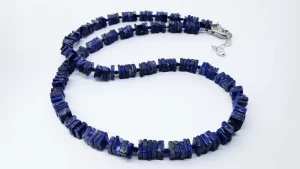
Uzbekistan is famous not only for its rich culture and traditions but also for the
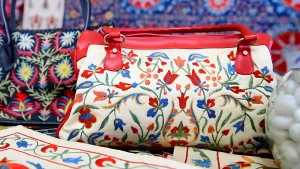
Magnificent Uzbek bags have long been symbols of handcraft and national pride. They embody the
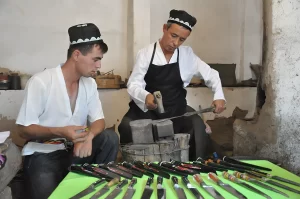
Uzbek knives are not only tools for everyday work but also works of art reflecting